ICANN Reveal Day recap: The new internet, mapped

On October 7, ICANN published the full list of new internet extensions that companies, communities and projects applied for, and who applied for each one. We went live on Doma onAir to go through it with domain industry veteran Jothan Frakes and D3's Fred Hsu and Kathy Nielsen.
"This is the first time in 14 years we're actually seeing the shape of the whole internet, the next internet." — Fred Hsu, CEO & Co-Founder D3, Doma onAir
First, what are we looking at?
An internet extension, also called a TLD (top-level domain), is whatever comes after the last dot in a web address: .com, .org, .ai. ICANN, the organization that oversees them, only opens the door to new ones every so often. The last time was 2012, which gave us extensions like .xyz, .app and .shop. This round brought in 1,616 applications.
A few words you'll see in this post:
- String: the text of an extension. In .agent, the string is "agent."
- Applicant: the company or group that applied to run an extension.
- Contested: more than one applicant applied for the same string.
Reveal Day by the numbers
- 986 different strings across those applications.
- Fewer strings than 2012, but more crowded. In 2012 there were about 1,400 strings. This time there are 986, with about 1.6 applicants for each one, up from about 1.4.
- 723 strings drew a single applicant. That's almost three in four.
- 263 strings are contested. They cover 891 of the applications, so more than half of all applications (55%) are competing with someone.
- 53 strings have five or more applicants.
So what does "contested" mean?
Think of two shops that want the same storefront. Only one can sign the lease, so someone has to sort it out first.
It works the same way here. Only one applicant can end up running an extension, so when several want the same one, ICANN has a process to resolve it before anyone can launch it.
The most contested extensions
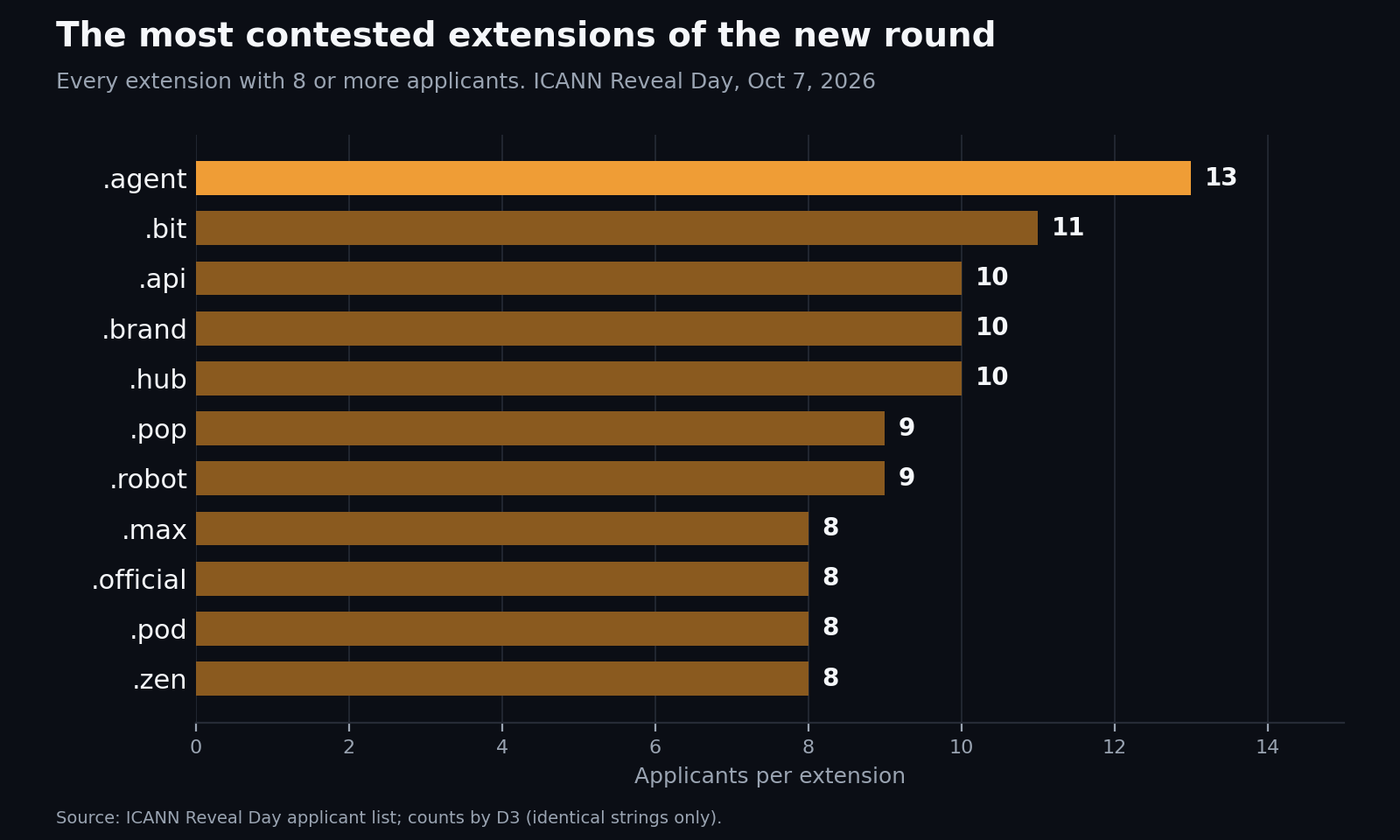
.agent leads by a clear margin with 13 applicants. The surprise in second place is .bit, with 11.
| Extension | Applicants |
|---|---|
| .agent | 13 |
| .bit | 11 |
| .api | 10 |
| .brand | 10 |
| .hub | 10 |
| .pop | 9 |
| .robot | 9 |
| .max | 8 |
| .official | 8 |
| .pod | 8 |
| .zen | 8 |
AI, crypto and developer words dominate the top of the list, but everyday words like .hub, .pop and .pod pulled big crowds too.
How the crypto extensions stacked up
Here's how some of the crypto-native extensions landed on the list:
| Extension | Applicants |
|---|---|
| .crypto | 5 |
| .wallet | 4 |
| .dao | 4 |
| .token | 3 |
| .coin | 3 |
| .moon | 3 |
| .bnb | 2 |
| .nft | 2 |
| .hype | 2 |
| .sol | 1 |
AI and agents: the most crowded neighborhood
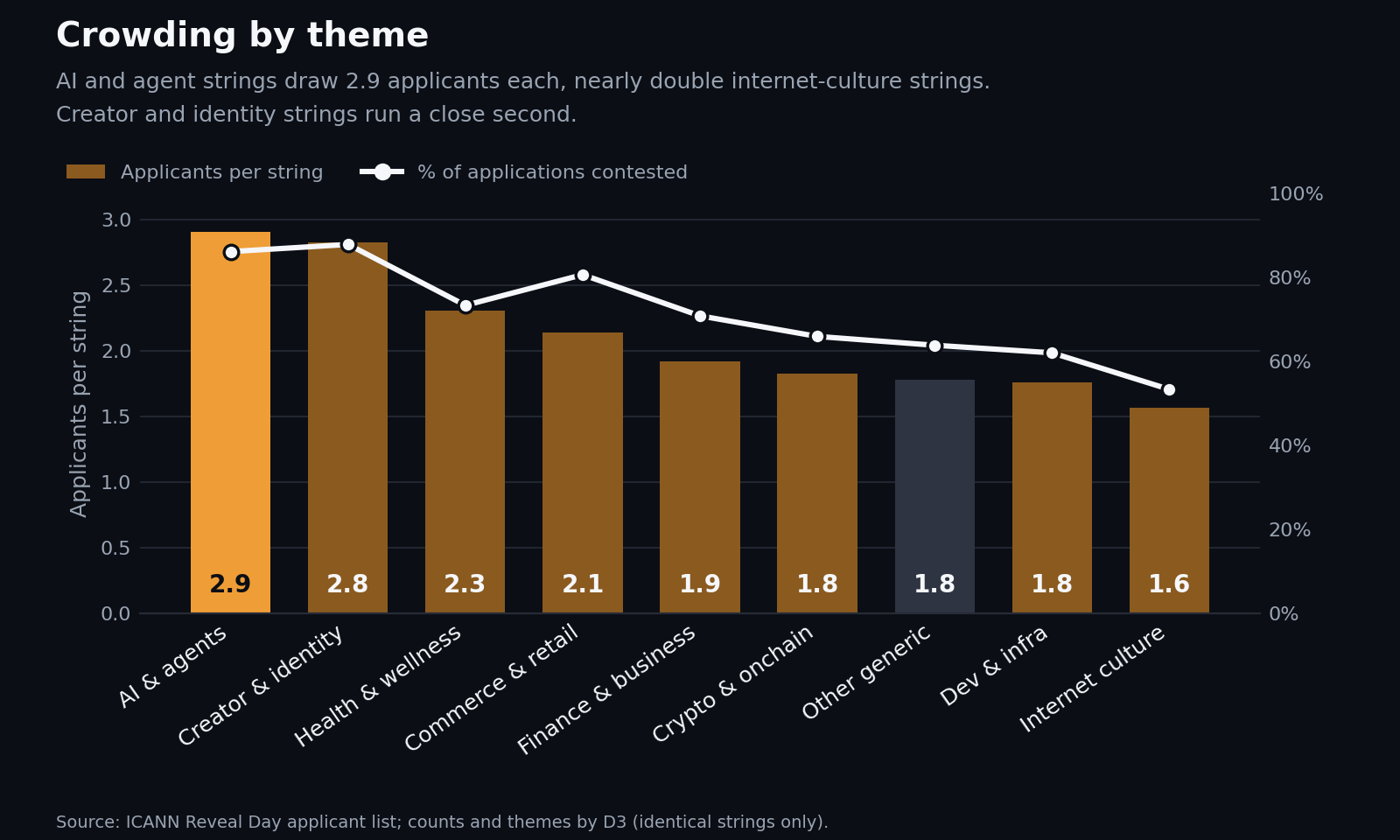
By our count, AI and agent strings drew about 2.9 applicants each, nearly double the roughly 1.6 for internet-culture strings such as slang and memes.
"Agent is the new black, right? Everything's agentic. So it's not a surprise to me that we had that many applicants for that particular string." — Jothan Frakes, Doma onAir
The big AI names showed up too. As we noted on the show, filings from OpenAI, Google and Meta all include .agent.
Why does it matter? Because the traffic on the internet is changing.
"We're moving to an agentic internet. We're moving to the traffic that is visiting a website. Is that going to be a human anymore?The domain name is that trusted anchor, allowing everything to happen in a safe way." — Kathy Nielsen, Director of BD, D3 - Doma onAir
- Meta filed 18 applications, from its own brands to strings like .metaverse and .superintelligence.
- Non-Latin scripts shrank. Extensions in scripts like Chinese or Arabic fell to 21 applications, down from 116 in 2012.
- Company names are a category of their own. 316 strings are brand names, usually with a single applicant.
What happens next
The list is the starting line, not the finish. Contested extensions need to be resolved, applications still have to be reviewed, and not every string on the list will make it to launch.
Where Frontier fits
Frontier is our membership program for the internet's next extensions. You deposit with supported vault providers, earn Frontier points, and commit them to the extensions you're backing to build priority ahead of general registration.
With the full list now public, we'll update each extension's status as the ICANN process and registry participation develop. Not every applied-for string will launch or join Frontier, and priority applies only where the registry participates and the extension completes the required launch steps.

Watch the full recording of Doma OnAir Episode 13: ICANN Reveal Day LIVE Ft. Jothan Frakes